Difference between revisions of "Masonic architecture"
(Create sourced architectural overview with an attributed comparison gallery) |
(Add a contextual video) |
||
| (2 intermediate revisions by the same user not shown) | |||
| Line 1: | Line 1: | ||
| − | '''Masonic architecture''' includes buildings commissioned for Freemasonry and older premises adapted for its use. These range from individual lodge meeting places to large halls containing administrative offices, dining rooms, libraries and museums. This overview follows selected examples in | + | '''Masonic architecture''' includes buildings commissioned for Freemasonry and older premises adapted for its use. These range from individual lodge meeting places to large halls containing administrative offices, dining rooms, libraries and museums. This overview follows selected examples in Europe, Africa, Asia, North America and Australia. |
== From rented rooms to permanent premises == | == From rented rooms to permanent premises == | ||
| Line 6: | Line 6: | ||
Permanent lodge premises had already appeared elsewhere. The [[Canongate Kilwinning|Chapel of St John in Edinburgh]] incorporates a lodge room built in 1735–1736 alongside earlier fabric. Its present appearance also includes later additions.<ref>Historic Environment Scotland, [https://portal.historicenvironment.scot/apex/f?p=1505:300:::::VIEWTYPE,VIEWREF:designation,LB28453 23 St John Street, Lodge Canongate Kilwinning], record LB28453.</ref> [[Phoenix Hall, Sunderland]], built in 1784–1785 to John Bonner's designs, is another surviving eighteenth-century example.<ref name="phoenix">Historic England, [https://historicengland.org.uk/listing/the-list/list-entry/1279903 Phoenix Hall], list entry 1279903, history and architectural description.</ref> | Permanent lodge premises had already appeared elsewhere. The [[Canongate Kilwinning|Chapel of St John in Edinburgh]] incorporates a lodge room built in 1735–1736 alongside earlier fabric. Its present appearance also includes later additions.<ref>Historic Environment Scotland, [https://portal.historicenvironment.scot/apex/f?p=1505:300:::::VIEWTYPE,VIEWREF:designation,LB28453 23 St John Street, Lodge Canongate Kilwinning], record LB28453.</ref> [[Phoenix Hall, Sunderland]], built in 1784–1785 to John Bonner's designs, is another surviving eighteenth-century example.<ref name="phoenix">Historic England, [https://historicengland.org.uk/listing/the-list/list-entry/1279903 Phoenix Hall], list entry 1279903, history and architectural description.</ref> | ||
| − | Purpose-built halls did not end the use of rented or adapted buildings. At Bath, successive shared premises proved short-lived and lodges returned to inns before buying the former Catholic chapel in Orchard Street in 1865. The building had originally been a theatre. Its adaptation retained the stage and reused some of the chapel seating.<ref>Old Theatre Royal, Bath, [https://oldtheatreroyal.com/museum/masonic-hall-since1865/ Masonic Hall — since 1865], account of successive meeting places and the conversion.</ref> | + | Purpose-built halls did not end the use of rented or adapted buildings. At [[Old Theatre Royal, Bath|Bath]], successive shared premises proved short-lived and lodges returned to inns before buying the former Catholic chapel in Orchard Street in 1865. The building had originally been a theatre. Its adaptation retained the stage and reused some of the chapel seating.<ref>Old Theatre Royal, Bath, [https://oldtheatreroyal.com/museum/masonic-hall-since1865/ Masonic Hall — since 1865], account of successive meeting places and the conversion.</ref> |
== Architectural styles == | == Architectural styles == | ||
| Line 15: | Line 15: | ||
File:Freemasons Hall Dublin geograph 1246534.jpg|[[Freemasons' Hall, Dublin]]. Jim Smillie, 2007; CC BY-SA 2.0. | File:Freemasons Hall Dublin geograph 1246534.jpg|[[Freemasons' Hall, Dublin]]. Jim Smillie, 2007; CC BY-SA 2.0. | ||
File:Masonic Temple Philadelphia Beyond My Ken 2013.jpg|[[Masonic Temple, Philadelphia]]. Beyond My Ken, 2013; CC BY-SA 4.0. | File:Masonic Temple Philadelphia Beyond My Ken 2013.jpg|[[Masonic Temple, Philadelphia]]. Beyond My Ken, 2013; CC BY-SA 4.0. | ||
| + | File:Sydney Masonic Centre Shkuru Afshar.jpg|[[Sydney Masonic Centre]], with the later Civic Tower above. Shkuru Afshar, 2022; CC BY-SA 4.0. | ||
</gallery> | </gallery> | ||
Different styles may occur within a single building. Dublin's Grand Lodge room uses classical columns, its Royal Arch room draws on Egyptian and Middle Eastern forms, and its Knights Templar room resembles a medieval chapel.<ref>Grand Lodge of Ireland, [https://freemason.ie/freemasons-hall/hall-gallery/ Freemasons' Hall Gallery]. Accessed 30 September 2026.</ref> | Different styles may occur within a single building. Dublin's Grand Lodge room uses classical columns, its Royal Arch room draws on Egyptian and Middle Eastern forms, and its Knights Templar room resembles a medieval chapel.<ref>Grand Lodge of Ireland, [https://freemason.ie/freemasons-hall/hall-gallery/ Freemasons' Hall Gallery]. Accessed 30 September 2026.</ref> | ||
| + | |||
| + | The reinforced-concrete [[Sydney Masonic Centre]], built in 1975–1978, belongs to the Brutalist tradition. Curved forms and broad wall surfaces define its exterior, while a three-storey foyer connects the principal interior spaces.<ref>Australian Institute of Architects, NSW Chapter, [https://www.architecture.com.au/wp-content/uploads/NSW-Chapter_Australian-Institute-of-Architects_Register-of-Significant-Architecture_February2021.pdf Register of Significant Buildings in NSW], February 2021, p. 83; City of Sydney, [https://meetings.cityofsydney.nsw.gov.au/documents/s42669/Attachment%20C1%20-%20Sydney%20Masonic%20Centre%20inventory.pdf Sydney Masonic Centre heritage inventory], 20 May 2020, physical description.</ref> | ||
| + | |||
| + | Neoclassical design also appears in [[Freemasons' Hall, Chennai]], opened in 1925. Its south-side portico uses Ionic columns to shelter the entrance from rain.<ref>Sriram V, [https://sriramv.com/2025/03/07/freemasons-hall-hundred-years-of-a-secret-landmark/ Freemasons Hall: Hundred Years of a 'Secret' Landmark], 7 March 2025.</ref> | ||
| + | |||
| + | The Scottish Rite’s Southern Jurisdiction introduces its House of the Temple in Washington, DC. The building offers a specific example of monumental classical design adapted to a modern Masonic headquarters. [https://www.youtube.com/watch?v=GmWmPaIeqC4 Watch the Southern Jurisdiction’s introduction to the House of the Temple]. | ||
| + | |||
| + | <youtube width="560" height="315">GmWmPaIeqC4</youtube> | ||
== Memorials and public collections == | == Memorials and public collections == | ||
| Line 25: | Line 34: | ||
Halls also provide homes for [[Masonic museums and libraries|collections]]. Dublin's library and archive support historical research, while Philadelphia's library and museum preserve books, documents and objects as well as maintaining the Temple itself.<ref>Grand Lodge of Ireland, [https://freemason.ie/museum-library-archive/ Museum, Library & Archive]; Masonic Temple, Library & Museum, [https://pamasonictemple.org/ institutional introduction and programmes].</ref> | Halls also provide homes for [[Masonic museums and libraries|collections]]. Dublin's library and archive support historical research, while Philadelphia's library and museum preserve books, documents and objects as well as maintaining the Temple itself.<ref>Grand Lodge of Ireland, [https://freemason.ie/museum-library-archive/ Museum, Library & Archive]; Masonic Temple, Library & Museum, [https://pamasonictemple.org/ institutional introduction and programmes].</ref> | ||
| + | |||
| + | [[De Goede Hoop Temple, Cape Town|De Goede Hoop in Cape Town]] also accommodated civic uses: its neighbouring banqueting hall housed the Cape House of Assembly from 1854 to 1884.<ref>South African History Online, [https://sahistory.org.za/place/lodge-de-goede-hoop-stal-square-cape-town Lodge de Goede Hoop, Stal Square, Cape Town], building history.</ref> | ||
== Alteration and conservation == | == Alteration and conservation == | ||
Latest revision as of 19:06, 9 November 2026
Masonic architecture includes buildings commissioned for Freemasonry and older premises adapted for its use. These range from individual lodge meeting places to large halls containing administrative offices, dining rooms, libraries and museums. This overview follows selected examples in Europe, Africa, Asia, North America and Australia.
From rented rooms to permanent premises
Early English Grand Lodge meetings moved between inns, taverns and livery halls. In 1774, the Grand Lodge acquired property in Great Queen Street, London; Thomas Sandby's hall was built behind the street frontage in 1775–1776. A tavern continued to occupy the front of the site.[1] The new hall also accommodated concerts, balls and meetings of learned and charitable societies.[2]
Permanent lodge premises had already appeared elsewhere. The Chapel of St John in Edinburgh incorporates a lodge room built in 1735–1736 alongside earlier fabric. Its present appearance also includes later additions.[3] Phoenix Hall, Sunderland, built in 1784–1785 to John Bonner's designs, is another surviving eighteenth-century example.[4]
Purpose-built halls did not end the use of rented or adapted buildings. At Bath, successive shared premises proved short-lived and lodges returned to inns before buying the former Catholic chapel in Orchard Street in 1865. The building had originally been a theatre. Its adaptation retained the stage and reused some of the chapel seating.[5]
Architectural styles
The surviving buildings show considerable variety. Phoenix Hall has a restrained classical frontage, while Freemasons' Hall, Dublin uses yellow sandstone and a prominent temple front.[4][6] Philadelphia's Masonic Temple has a Romanesque exterior and rooms decorated in several historical styles by George Herzog.[7]

Phoenix Hall, Sunderland. JeanneA 57, 2016; CC BY-SA 4.0.

Freemasons' Hall, Dublin. Jim Smillie, 2007; CC BY-SA 2.0.
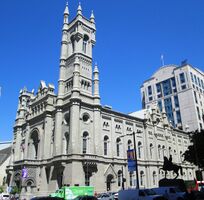
Masonic Temple, Philadelphia. Beyond My Ken, 2013; CC BY-SA 4.0.

Sydney Masonic Centre, with the later Civic Tower above. Shkuru Afshar, 2022; CC BY-SA 4.0.


Different styles may occur within a single building. Dublin's Grand Lodge room uses classical columns, its Royal Arch room draws on Egyptian and Middle Eastern forms, and its Knights Templar room resembles a medieval chapel.[8]
The reinforced-concrete Sydney Masonic Centre, built in 1975–1978, belongs to the Brutalist tradition. Curved forms and broad wall surfaces define its exterior, while a three-storey foyer connects the principal interior spaces.[9]
Neoclassical design also appears in Freemasons' Hall, Chennai, opened in 1925. Its south-side portico uses Ionic columns to shelter the entrance from rain.[10]
The Scottish Rite’s Southern Jurisdiction introduces its House of the Temple in Washington, DC. The building offers a specific example of monumental classical design adapted to a modern Masonic headquarters. Watch the Southern Jurisdiction’s introduction to the House of the Temple.
Memorials and public collections
Some Masonic buildings have an explicit commemorative purpose. The present Freemasons' Hall in London was built in 1927–1933 as a memorial to members who died in the First World War. Its Art Deco design belongs to a different period from Sandby's eighteenth-century hall.[2]
The George Washington Masonic National Memorial in Alexandria, Virginia, commemorates Washington through a building combining classical forms with a tall stepped tower. Its landmark assessment places the design within the development of early twentieth-century skyscraper architecture.[11]
Halls also provide homes for collections. Dublin's library and archive support historical research, while Philadelphia's library and museum preserve books, documents and objects as well as maintaining the Temple itself.[12]
De Goede Hoop in Cape Town also accommodated civic uses: its neighbouring banqueting hall housed the Cape House of Assembly from 1854 to 1884.[13]
Alteration and conservation
A surviving hall may contain work from several periods. Phoenix Hall's banqueting accommodation and entrance range were added long after the original lodge room.[4] In Dublin, the principal building was reported complete in 1869, while the Egyptian-style Royal Arch room was designed in 1871.[14] Building histories therefore need to distinguish initial construction, later decoration and subsequent adaptation.
Related articles
- The Layout of the Craft Lodge
- The Five Classical Orders of Architecture
- The Masonic Million Memorial Fund
- Masonic buildings and memorials
References
- ↑ Historic England, Grand Connaught Rooms, list entry 1393970, history.
- ↑ 2.0 2.1 United Grand Lodge of England, History of Freemasons' Hall. Accessed 30 September 2026.
- ↑ Historic Environment Scotland, 23 St John Street, Lodge Canongate Kilwinning, record LB28453.
- ↑ 4.0 4.1 4.2 Historic England, Phoenix Hall, list entry 1279903, history and architectural description.
- ↑ Old Theatre Royal, Bath, Masonic Hall — since 1865, account of successive meeting places and the conversion.
- ↑ National Inventory of Architectural Heritage, Freemasons' Hall, Dublin, record 50100107.
- ↑ National Park Service, Masonic Temple: National Register of Historic Places Inventory—Nomination Form, sections 7 and 8.
- ↑ Grand Lodge of Ireland, Freemasons' Hall Gallery. Accessed 30 September 2026.
- ↑ Australian Institute of Architects, NSW Chapter, Register of Significant Buildings in NSW, February 2021, p. 83; City of Sydney, Sydney Masonic Centre heritage inventory, 20 May 2020, physical description.
- ↑ Sriram V, Freemasons Hall: Hundred Years of a 'Secret' Landmark, 7 March 2025.
- ↑ George Washington Masonic National Memorial Association, National Historic Landmark Designation Details, architectural significance.
- ↑ Grand Lodge of Ireland, Museum, Library & Archive; Masonic Temple, Library & Museum, institutional introduction and programmes.
- ↑ South African History Online, Lodge de Goede Hoop, Stal Square, Cape Town, building history.
- ↑ Irish Architectural Archive, Dictionary of Irish Architects: Freemasons' Hall, Molesworth Street, entries for Holmes and Ferguson.
| Explore the Freemasonry Wiki: Full article index · All articles · All categories · Random article |
