|
|
| (4 intermediate revisions by the same user not shown) |
| Line 1: |
Line 1: |
| − | =Freemason's Hall= | + | [[File:Freemasons Hall London exterior Ethan Doyle White 2016.jpg|thumb|center|250px|alt=The entrance tower of Freemasons' Hall, London, faced in pale stone.|Freemasons' Hall, photographed by Ethan Doyle White in 2016. CC BY-SA 4.0.]] |
| | + | '''Freemasons' Hall''', at 60 Great Queen Street, London, is the headquarters of the United Grand Lodge of England. The present building was constructed in 1927–1933 as the '''Masonic Peace Memorial Building''', commemorating Freemasons killed in the First World War. It is listed at Grade II*.<ref name="listing">Historic England, [https://historicengland.org.uk/listing/the-list/list-entry/1113218 Freemasons Hall], National Heritage List for England, entry 1113218.</ref><ref name="hall">United Grand Lodge of England, [https://www.ugle.org.uk/freemasons-hall Freemasons' Hall]. Accessed 30 September 2026.</ref> |
| | | | |
| − | [[File:Freemasons_Hall_UGLE.jpg|400px|right]]The United Grand Lodge of England (UGLE) building, also known as Freemasons' Hall, is the headquarters of the UGLE and the principal meeting place for Masonic Lodges in London. Located at 60 Great Queen Street, the building has an intriguing history that spans over 250 years.
| + | == Earlier halls == |
| | + | The Premier Grand Lodge announced plans for a central hall in 1769 and acquired a site in Great Queen Street in 1774. Thomas Sandby designed a hall in the garden between two existing houses. It was dedicated on 23 May 1776 and accommodated concerts, balls and meetings of learned and charitable societies as well as Masonic gatherings.<ref name="history">United Grand Lodge of England, [https://www.ugle.org.uk/freemasons-hall/history-freemasons-hall History of Freemasons' Hall].</ref> |
| | | | |
| − | Here is a timeline of the building's history:
| + | John Soane remodelled parts of the premises in the 1820s. Frederick Pepys Cockerell's extensions followed in 1862–1869. The replacement of these earlier buildings proceeded in stages during construction of the present hall.<ref name="history" /> |
| | | | |
| − | *Formation of Premier Grand Lodge (1717): On June 24, 1717, four London Lodges came together to form the Premier Grand Lodge of England at the Goose and Gridiron Alehouse in St. Paul's Churchyard. This marked the beginning of organised Freemasonry in England.
| + | == The twentieth-century memorial == |
| | + | [[The Masonic Million Memorial Fund]] raised money for the new headquarters and war memorial. Ashley and Newman won the architectural competition in 1926. Construction began in 1927, and the Duke of Connaught dedicated the completed hall on 19 July 1933.<ref>Museum of Freemasonry, [https://museumfreemasonry.org.uk/stories/hall-stone-story The Hall Stone story].</ref><ref name="history" /> |
| | | | |
| − | *Purchase of land at Great Queen Street (1765): In 1765, the then Grand Lodge purchased a piece of land on Great Queen Street for the construction of a new headquarters, Freemasons' Tavern.
| + | The architects fitted the building to an irregular site, using a steel frame faced with Portland stone. Historic England describes the exterior as stripped Classical, while UGLE places the hall within London's Art Deco architecture. The Grand Temple has marble wall linings, mosaics, a decorated ceiling and bronze doors by Walter and Donald Gilbert. A library and reading room formed part of the building's principal accommodation.<ref name="listing" /><ref name="hall" /> |
| | | | |
| − | *Freemasons' Tavern and Hall (1775–1869): The Freemasons' Tavern, designed by architect Thomas Sandby, was completed in 1775. The tavern served as the meeting place for the organisation, and the first Grand Lodge meeting took place there on May 23, 1776. Later, in 1860, a new hall was added to the existing building, designed by architect Frederick Pepys Cockerell.
| + | == Memorial Shrine and Roll of Honour == |
| | + | The Memorial Shrine stands in the vestibule outside the Grand Temple, beneath a stained-glass memorial window. Its bronze casket contains a decorated parchment Roll of Honour naming Freemasons who died during the First World War. Handles allow the scroll to be turned so that successive names can be read.<ref name="shrine">Museum of Freemasonry, [https://museumfreemasonry.org.uk/node/576 The heart of the Hall], 20 June 2019.</ref> |
| | | | |
| − | *The merger of the two Grand Lodges (1813): On December 27, 1813, the Premier Grand Lodge of England and the Antients' Grand Lodge (established in 1751) merged to form the United Grand Lodge of England, with the Duke of Sussex as its first Grand Master.
| + | The shrine was completed after the opening of the building. The Building Committee announced plans for it in 1938 and reported completion to Grand Lodge on 5 June 1940. Walter Gilbert designed the metalwork, which includes figures representing the Royal Navy, Royal Marines, Army and Royal Flying Corps.<ref name="shrine" /> |
| | | | |
| − | *Decision to construct a new building (1913): In 1913, the UGLE decided to construct a new building to commemorate the 250th anniversary of the Grand Lodge. A design competition was held, and architects Henry Victor Ashley and F. Winton Newman's design was selected.
| + | The scroll differs from the printed Roll of Honour issued in 1921. That book contained 3,078 names; the museum records more than 350 additional names on the shrine's scroll, as well as extra lodge details for some men already listed. The two records therefore represent different stages in the compilation of the memorial.<ref name="shrine" /> |
| | | | |
| − | *Construction of the new building (1927–1933): The construction of the new Freemasons' Hall began in 1927, and the foundation stone was laid by the Duke of Connaught, the then Grand Master, on July 14, 1927. The building was completed in 1933 and was dedicated to the Freemasons who lost their lives in World War I.
| + | == Museum and public use == |
| | + | The hall contains the Museum of Freemasonry and provides exhibitions and guided visits. Its library and archives are among the resources discussed in [[Masonic museums and libraries]].<ref name="hall" /> |
| | | | |
| − | *World War II (1939–1945): During World War II, the Freemasons' Hall was damaged due to bombing, but the building remained functional. After the war, necessary repairs and restoration work were carried out.
| + | In 1985 the hall reopened more fully to public use, including non-Masonic events and film and television production. UGLE continues to offer spaces for events and filming alongside the building's Masonic functions.<ref name="history" /><ref name="hall" /> |
| | | | |
| − | *Renovations and the addition of the Museum of Freemasonry (1972–1986): In 1972, the museum area was extended, and in 1986, the Museum of Freemasonry was officially opened by the Duke of Kent, the then Grand Master. The museum contains an extensive collection of Masonic artefacts and hosts exhibitions. | + | == Related articles == |
| | + | * [[The Masonic Million Memorial Fund]] |
| | + | * [[Masonic charity jewels]] |
| | + | * [[Masonic museums and libraries]] |
| | + | * [[The Union of 1813]] |
| | | | |
| − | Today, the Freemasons' Hall at 60 Great Queen Street serves as the headquarters of the United Grand Lodge of England and hosts various Masonic ceremonies, meetings, and events. The building is also open to the public for tours, and the Museum of Freemasonry is a popular attraction.
| + | == References == |
| − | | + | <references /> |
| − | ==Museum== | |
| − | | |
| − | In London, at 60 Great Queen Street, within Freemasons' Hall, the Museum of Freemasonry is an intriguing attraction for those with an interest in the symbolism, history, and culture of Freemasonry. By preserving and exhibiting an extensive collection of Masonic artefacts and ephemera, the museum provides a one-of-a-kind glimpse into the Freemasonry world.
| |
| − | | |
| − | In addition to permanent galleries, the Museum of Freemasonry also features temporary exhibitions. A variety of Freemasonry-related topics are available for exploration by visitors, such as the institution's historical evolution, ceremonies, symbols, regalia, and societal influence. Some highlights of the museum include:
| |
| − | | |
| − | *'''Library and Archives''': The museum houses a vast collection of books, manuscripts, and archives related to Freemasonry. The library is an essential resource for researchers and scholars studying the history and development of Freemasonry.
| |
| − | | |
| − | *'''Masonic Regalia''': An extensive assortment of ceremonial garments, such as aprons, collars, gemstones, and more, is on display at the museum. A number of these are intricately crafted and date back to the 18<sup>th</sup> century, reflecting the importance of symbolism in Freemasonry.
| |
| − | | |
| − | *'''Ceremonial Furniture and Artifacts''': The museum showcases a range of ceremonial furniture, such as Masonic tracing boards, altars, and columns, which were used in Masonic ceremonies and rituals. Additionally, visitors can view other artefacts, including glassware, ceramics, and coins, with Masonic symbols and designs.
| |
| − | | |
| − | *'''Paintings and Portraits''': The museum's collection includes a variety of paintings and portraits featuring prominent Freemasons, such as King George IV, the Duke of Sussex, and the Duke of Wellington. The artwork on display provides a glimpse into the organisation's history and the notable individuals who have been involved in Freemasonry.
| |
| − | | |
| − | *'''Temporary Exhibitions''': The Museum of Freemasonry regularly hosts temporary exhibitions focusing on specific themes, events, or aspects of Freemasonry. These exhibitions offer an opportunity for visitors to explore new perspectives and learn about different facets of the organisation.
| |
| − | | |
| − | Admission to the Museum of Freemasonry is complimentary and accessible to the general public. Those interested in learning more about the history, rituals, and symbolism of Freemasonry, as well as its function in society over the centuries, will find this an invaluable resource. Guided tours of Freemasons' Hall, which include access to the museum, are also available.
| |
| − | | |
| − | ==The London Fashion Show==
| |
| − | | |
| − | The hall has become a popular venue for various events, including fashion shows. One notable fashion event that has taken place at Freemasons' Hall is London Fashion Week (LFW).
| |
| − | | |
| − | London Fashion Week is a biannual event organized by the British Fashion Council (BFC) that showcases the latest collections from both established and emerging designers. It typically takes place in February (for the Autumn/Winter collections) and September (for the Spring/Summer collections) and attracts international attention from the fashion industry, press, and buyers.
| |
| − | | |
| − | Freemasons' Hall has hosted runway shows, presentations, and designer showrooms for LFW events. The building's striking architecture, featuring an opulent mix of Art Deco and neo-classical elements, provides a unique and grand setting for fashion events.
| |
| − | | |
| − | The choice of Freemasons' Hall as a venue for LFW highlights the building's versatility and its ability to accommodate a diverse range of events beyond its primary function as the headquarters for the United Grand Lodge of England.
| |
| − | | |
| − | ==Spooks, BBC Series==
| |
| − | | |
| − | The BBC television drama series "Spooks," also known as "MI-5" in some countries, is a popular British spy drama that aired from 2002 to 2011. The show follows the work of a group of MI5 intelligence officers as they tackle various threats to national security. The series is known for its gripping storylines, fast-paced action, and use of real-life locations throughout London and the United Kingdom.
| |
| − | | |
| − | The Freemasons' Hall served as the location for the production of several episodes of "Spooks." The stunning Art Deco and neoclassical architecture of the building served as the perfect setting for the show's covert, high-stakes operations. In various scenes, the majestic interior of Freemasons' Hall, including the Grand Temple, was prominently featured.
| |
| − | | |
| − | ==Bits and Bobs==
| |
| − | | |
| − | The halls have a long and rich history. Here are some interesting facts, scandals, and anecdotes about the hall:
| |
| − | | |
| − | *Architectural competition: The current design of Freemasons' Hall resulted from an architectural competition held in 1913. The winning design, by architects Henry Victor Ashley and F. Winton Newman, combined elements of Art Deco and neo-classical styles.
| |
| − | | |
| − | *WWI memorial: The Freemasons' Hall serves as a memorial to the Freemasons who lost their lives during World War I. A bronze memorial shrine in the building's vestibule bears the names of over 3,000 fallen Freemasons.
| |
| − | | |
| − | *WWII bomb damage: During World War II, Freemasons' Hall sustained damage from German bombings. Despite sustaining damage, the building remained functional and underwent repairs after the war.
| |
| − | | |
| − | *Royal connections: A number of members of the British Royal Family, including the Duke of Sussex, the Duke of Connaught, and the Duke of Kent, have held highly-ranking positions within Freemasonry.
| |
| − | | |
| − | *Music and the Freemasons: Mozart and Haydn, among other famous composers, were Freemasons. A collection of musical artefacts is housed in the museum at Freemasons' Hall, including handwritten sheet music by Mozart for his Masonic compositions.
| |
| − | | |
| − | *Fashion and film location: Freemasons' Hall has become a sought-after venue for various events, including London Fashion Week, and has served as a filming location for several television shows and movies, such as the BBC series "Spooks" and the 2017 film adaptation of Agatha Christie's "Murder on the Orient Express."
| |
| − | | |
| − | *The Covent Garden location: Freemasons' Hall is located in the Covent Garden area of London, which is historically associated with the arts and entertainment. The building is situated near the Royal Opera House and several West End theatres.
| |
| − | | |
| − | *Public tours and events: Freemasons' Hall offers regular public tours, allowing visitors to explore the impressive architecture and learn about the history of Freemasonry. The building also hosts various events, such as concerts, lectures, and exhibitions.
| |
| | | | |
| | {{Topic navigation}} | | {{Topic navigation}} |
| | | | |
| − | [[Category:Places and buildings]] | + | [[Category:Craft Freemasonry]] |
| | + | [[Category:Masonic buildings and memorials]] |
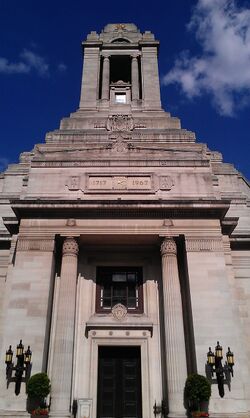
Freemasons' Hall, photographed by Ethan Doyle White in 2016. CC BY-SA 4.0.
Freemasons' Hall, at 60 Great Queen Street, London, is the headquarters of the United Grand Lodge of England. The present building was constructed in 1927–1933 as the Masonic Peace Memorial Building, commemorating Freemasons killed in the First World War. It is listed at Grade II*.[1][2]
Earlier halls
The Premier Grand Lodge announced plans for a central hall in 1769 and acquired a site in Great Queen Street in 1774. Thomas Sandby designed a hall in the garden between two existing houses. It was dedicated on 23 May 1776 and accommodated concerts, balls and meetings of learned and charitable societies as well as Masonic gatherings.[3]
John Soane remodelled parts of the premises in the 1820s. Frederick Pepys Cockerell's extensions followed in 1862–1869. The replacement of these earlier buildings proceeded in stages during construction of the present hall.[3]
The twentieth-century memorial
The Masonic Million Memorial Fund raised money for the new headquarters and war memorial. Ashley and Newman won the architectural competition in 1926. Construction began in 1927, and the Duke of Connaught dedicated the completed hall on 19 July 1933.[4][3]
The architects fitted the building to an irregular site, using a steel frame faced with Portland stone. Historic England describes the exterior as stripped Classical, while UGLE places the hall within London's Art Deco architecture. The Grand Temple has marble wall linings, mosaics, a decorated ceiling and bronze doors by Walter and Donald Gilbert. A library and reading room formed part of the building's principal accommodation.[1][2]
Memorial Shrine and Roll of Honour
The Memorial Shrine stands in the vestibule outside the Grand Temple, beneath a stained-glass memorial window. Its bronze casket contains a decorated parchment Roll of Honour naming Freemasons who died during the First World War. Handles allow the scroll to be turned so that successive names can be read.[5]
The shrine was completed after the opening of the building. The Building Committee announced plans for it in 1938 and reported completion to Grand Lodge on 5 June 1940. Walter Gilbert designed the metalwork, which includes figures representing the Royal Navy, Royal Marines, Army and Royal Flying Corps.[5]
The scroll differs from the printed Roll of Honour issued in 1921. That book contained 3,078 names; the museum records more than 350 additional names on the shrine's scroll, as well as extra lodge details for some men already listed. The two records therefore represent different stages in the compilation of the memorial.[5]
Museum and public use
The hall contains the Museum of Freemasonry and provides exhibitions and guided visits. Its library and archives are among the resources discussed in Masonic museums and libraries.[2]
In 1985 the hall reopened more fully to public use, including non-Masonic events and film and television production. UGLE continues to offer spaces for events and filming alongside the building's Masonic functions.[3][2]
Related articles
References
- ↑ 1.0 1.1 Historic England, Freemasons Hall, National Heritage List for England, entry 1113218.
- ↑ 2.0 2.1 2.2 2.3 United Grand Lodge of England, Freemasons' Hall. Accessed 30 September 2026.
- ↑ 3.0 3.1 3.2 3.3 United Grand Lodge of England, History of Freemasons' Hall.
- ↑ Museum of Freemasonry, The Hall Stone story.
- ↑ 5.0 5.1 5.2 Museum of Freemasonry, The heart of the Hall, 20 June 2019.
