Traditional Martinist Order

The Traditional Martinist Order (TMO, French Ordre Martiniste Traditionnel) is a school of Martinism founded in Paris in 1931. Its members study the writings of Louis-Claude de Saint-Martin and a question he put at the centre of the spiritual life. How can a person recover an inward relationship with the divine? Its three principal degrees are Associate, Mystic and Superior. Today the Order works under the auspices of the Ancient and Mystical Order Rosae Crucis (AMORC), a Rosicrucian organisation. In Britain it offers both written study at home and instruction with initiation in a local group.[1][2][3]
The three degrees
Each degree couples a ceremony of admission with a period of study. The Order gives a minimum of six years for the three initiations and their associated teaching in a Heptad. Older English-language discourses give concrete examples of what a student was asked to consider at each stage.[4][5]
- Associate. Three lamps illuminate the same space. The Associate is invited to see how several sources can contribute to one truth. The mask raises a more personal question. When a roomful of people can no longer distinguish one another by face or rank, on what grounds do they judge an idea or an action? The first degree asks members to set aside the social standing they bring through the door.[5]
- Mystic. The two columns introduce the problem of opposition. In the older discourse, someone drawn entirely to either pole loses the ability to act freely. The student moves from recognising opposites to finding a balance between them. The degree relates this work to reintegration, the Martinist teaching that human beings can recover the spiritual relationship lost in the Fall.[5][4]
- Superior or Unknown Superior (Supérieur Inconnu, abbreviated S.I.). An older exercise asks the candidate to explain what the first two degrees have taught them and why they seek to continue. The instruction connects the title with sharing what one has learned for the benefit of others. The return to anonymity connects the third degree to the first. Members are asked to help others without seeking credit.[5]
Further study is available in the Circle of Unknown Philosophers. The Order’s French booklet describes applying to the Circle after the three foundational degrees. The English archival catalogue likewise places its monographs after the third-degree lessons.[6][2]
The pantacle, the cloak and the inner temple
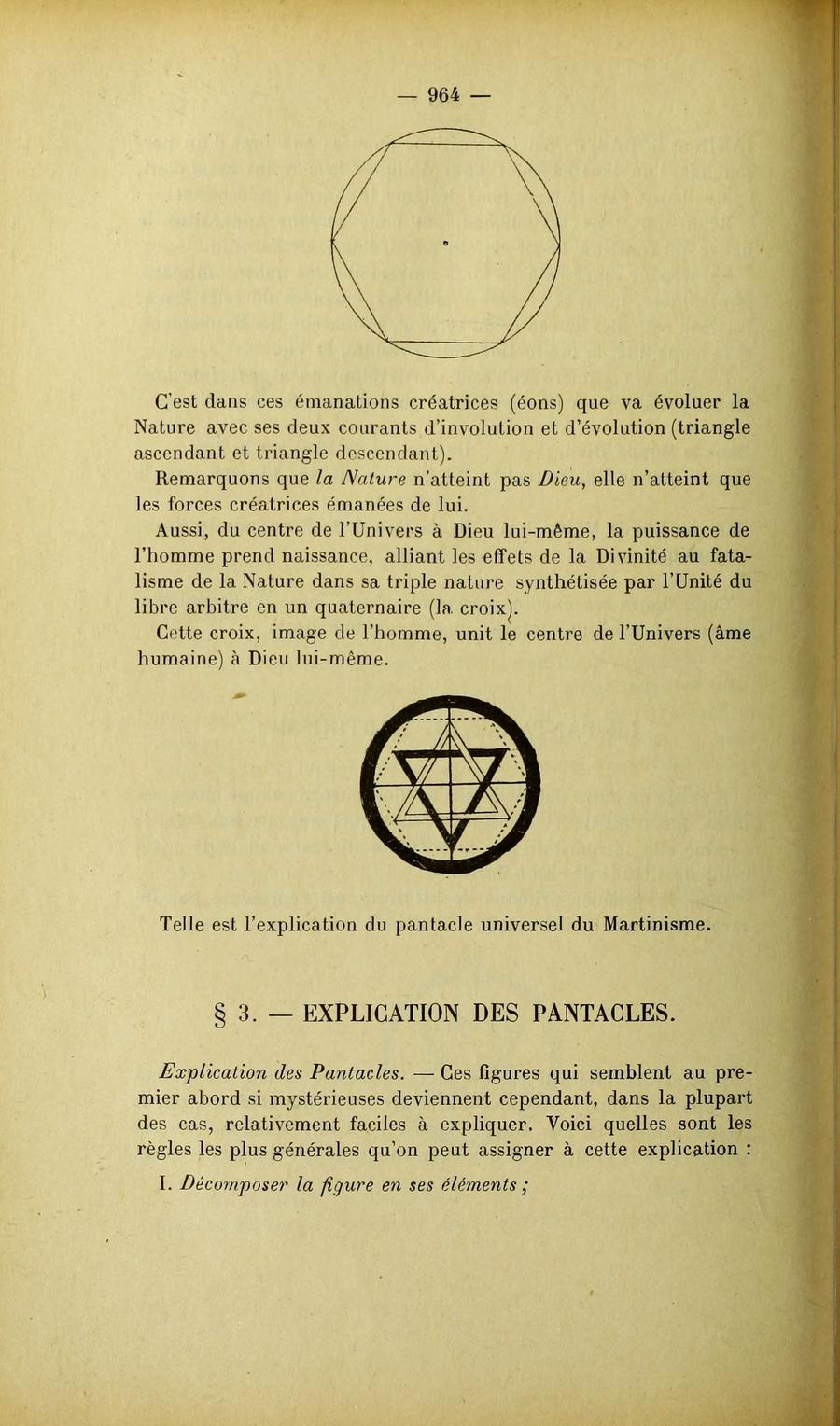
The pantacle is the Order’s emblem, a diagram meant to be read one shape at a time. In his 1891 account, Papus began with a circle for eternity. Its radius can be stepped around the circumference six times, giving the six periods of creation, with the centre marking the seventh period of rest. In the Order’s modern explanation the dark triangle signifies the material world and the light triangle the spiritual world. Their interlacing puts both within one creation. Papus read the central cross as the human being whose freedom makes a relationship with God possible.[7]
The cloak turns attention from the cosmos to everyday conduct. In her essay on it, Martinist teacher Julie Scott recalls Elijah passing his mantle to Elisha. The gift calls the recipient to take up another person’s work. Scott also reads the cloak as a means of inward withdrawal, giving a person time to decide how to respond to provocation. The Order calls the longer work of changing one’s conduct the rebuilding of the inner temple. Saint-Martin gave the idea an everyday measure when he wrote, “let us begin by being faithful in small things”.[8][4][9]
Who can join in Britain?
The Order admits women and men. Its British guidance lists a Rosicrucian qualification for temple work and gives no Craft or Royal Arch prerequisite. British enquiries go to the English Grand Lodge for Europe and Africa, which publishes two routes.[3][10]
- Oratory membership is for home study. British students receive written lessons. A personal observance can mark the start of each stage, while the three traditional initiations take place in a temple. The British bulletin assigns the First Temple Degree prerequisite specifically to the temple route. Its enquiry form asks for a membership number and leaves eligibility for British home-study applicants outside AMORC unstated. The French jurisdiction expressly opens home study to non-Rosicrucians. The British office supplies its own application.[3][4][11]
- Heptad or Atelier membership is for group work. In Britain the applicant must already have received AMORC’s First Temple Degree in a lodge. A Heptad is a local body traditionally led by seven officers. An Atelier is a smaller workshop. Members hear a discourse, discuss its meaning and receive initiation in person from an authorised officer. An Atelier can confer the Associate initiation. A Heptad offers the full sequence.[3][10][4]
To request the British introductory booklet, application form or details of a local group, the Grand Lodge gives tmo@amorc.org.uk. The separate Martinist Order of the Golden and Rosy+Cross has its own admissions process.[3]
From the Paris circle to AMORC

Saint-Martin (1743–1803) had belonged to Martinès de Pasqually’s Élus Coëns and translated the writings of Jakob Böhme. His account of inward renewal became known as the Way of the Heart. The organised Martinist Order came later. In Paris in 1891, Papus and Augustin Chaboseau established a Supreme Council. Both claimed to have received a personal transmission going back to Saint-Martin. Historians can trace the influence of Saint-Martin’s books more securely than every link in those initiatory genealogies.[1][12]
On 24 July 1931, Augustin Chaboseau, the poet Victor-Émile Michelet and the publisher known as Chamuel revived the Paris work under the name Ordre Martiniste Traditionnel. All three had participated in the earlier council. Their choice of Traditionnel expressed a claim to preserve its principles, including the admission of women, at a time when several bodies claimed to continue the work of Papus. Chaboseau passed the leadership to Michelet in 1932 and resumed it after Michelet’s death in 1938. A declaration dated 10 August 1939, printed in the Rosicrucian Digest the following February, sets out the council’s own reasons for the revival.[13][14]
Ralph Maxwell Lewis connected the Paris council with AMORC in America. Two events in his career explain why accounts of this connection differ. In 1936 Victor Blanchard initiated Lewis into the Ordre Martiniste et Synarchique. The TMO’s official history dates his reception by Georges Lagrèze, acting for Chaboseau, to 1 September 1939. Historian Serge Caillet reads the certificate of that date as recognition of Lewis’s earlier initiation. A separate decree of 16 October 1939 confirmed Lewis’s authority to organise a regional council in the United States. The authority to establish the American body is thus documented even where accounts of the September ceremony differ.[1][15]
After Augustin Chaboseau died in 1946, his son Jean sought to suspend the Order’s activity in 1947. The American organisation continued under AMORC, and AMORC sponsored the expansion of French Heptads in the 1960s. Today the two organisations share leadership. AMORC’s Imperator, Claudio Mazzucco, also presides over the TMO’s Supreme Council as Sovereign Grand Master. Martinist affiliation still has its own application, lessons and initiations.[13][1][3]
Further viewing
In The Traditional Martinist Order, Julie Scott, Julian Johnson and Michael Shaluly describe what they learned from studying at home and meeting other Martinists in local groups.
References
- ↑ 1.0 1.1 1.2 1.3 Traditional Martinist Order, History of the Traditional Martinist Order.
- ↑ 2.0 2.1 Stichting Argus, Martinist Library, “Traditional Martinist Order”. The catalogue identifies all three sets of degree discourses and the later Circle of Unknown Philosophers materials.
- ↑ 3.0 3.1 3.2 3.3 3.4 3.5 English Grand Lodge for Europe and Africa, AMORC, May 2026 bulletin, p. 6, “Traditional Martinist Order”.
- ↑ 4.0 4.1 4.2 4.3 4.4 Traditional Martinist Order, About Martinism, sections on teachings, home study and Heptad membership.
- ↑ 5.0 5.1 5.2 5.3 Traditional Martinist Order, historical English-language discourses and ritual texts, especially the Associate instruction on the three lights and mask, Mystic Discourse Six and the concluding exercise for the Superior degree.
- ↑ Ordre Martiniste Traditionnel, Lumière Martiniste (2017), “L’affiliation martiniste”.
- ↑ Papus, Traité méthodique de science occulte (Paris, 1891), pp. 963–964. Ordre Martiniste Traditionnel, La signification du Pantacle des Martinistes.
- ↑ Julie Scott, “The Cloak”, Rosicrucian Digest, vol. 92, no. 1 (2014), pp. 44–48.
- ↑ Louis-Claude de Saint-Martin to Niklaus Anton Kirchberger, letter CX, 19 June 1797, Theosophic Correspondence.
- ↑ 10.0 10.1 Traditional Martinist Order, The Light of Martinism, introductory description and “Becoming a Martinist”.
- ↑ Ordre Martiniste Traditionnel, Les études martinistes, on the oral and written routes in its jurisdiction.
- ↑ Massimo Introvigne, “Martinism: Second Period”, in Wouter J. Hanegraaff, ed., Dictionary of Gnosis and Western Esotericism (Brill), pp. 780–783.
- ↑ 13.0 13.1 Ordre Martiniste Traditionnel, Le Martinisme à l’époque moderne, sections on the 1931 revival, the war and the post-war Order.
- ↑ Supreme Council of the Traditional Martinist Order, declaration of 10 August 1939, reproduced in Rosicrucian Digest, February 1940.
- ↑ Serge Caillet, “Los Martinistas de la F.U.D.O.S.I. y la Orden Martinista Tradicional”, GEIMME Boletín Informativo 31, pp. 15–17, on the certificates and the October decree.
| Explore the Freemasonry Wiki: Full article index · All articles · All categories · Random article |